
“I could not say, exactly, what I learned from listening to Bishop, over and over again, as my father drove across the west in his green Suburban—a car he purchased from my mother’s ex-boyfriend, then refused to sell, reasoning it had done enough damage already to the earth and should be quietly retired from its consumption of fossil fuels. I did not learn anything particular or nameable—some specific aspect of the craft. I learned something more permanent than that.”

“I think H.D.’s Sea Garden is as fine a first book of poems as the last century produced. . . . I hardly know what to say about it. There is a quality of thought and feeling, of actual vision in the midst of allegorizing itself, a sense that the hour is equally eternity, and eternity equally an hour, that just shatters me. I find in it, poem after poem, an example of what it is to be thrown into the world and have nothing else to teach you how to live in that condition but the world itself.”

“Aram Saroyan is perhaps most famous as the target of conservative political outrage over a $750 payment for the inclusion of his one-word poem “lighght” (1968) in an NEA-funded anthology twenty-five years after its original publication. Like “lighght” but written a year later, “lobstee” presents a single, misspelled word in the middle of an otherwise blank page: lobstee.
[…]
We typically talk about the lobster/lobstee relationship as parallel to employer/employee, which then leads to the question of what exactly it means “to lobst” – the activity of a lobst-er. Once, a student pointed out that it was a key stroke error, that the “e” and “r” are beside each other on the standard QWERTY keyboard, which open onto a conversation about how this poem was likely composed on a typewriter and how we can talk about the ways in which the technology of writing changes how and what we write. It’s a lovely poem to talk about with students!”
“When writing my second book, Utopia Minus, I became obsessed with landscape and cultural memory. I was taking tours in my mind. I love falling asleep somewhere over Kansas and waking up on the tarmac in San Francisco. But I also relish the process of taking things mile by mile, word by word, to notice every historical marker, strip mall, roadside curiosity, to savor every preposition, verb, clause. A glimpse from a jet plane like any good fragment can illuminate, but a sentence leads us step by step through the procedures of thought and syntax.”

“I have a very clear memory of ordering Levis’s Winter Stars and walking to the campus post office to pick it up; I read a pretty big chunk of it while walking home, and by the time I got back to my dorm, I’d decided I wanted to read everything he’d written.”
“In Dark Traffic especially, Kane sets a scene through her command of pacing and sonic dissonance. If consolation is ‘the small gesture of sound,’ Kane writes defiantly into the wind, the howl, and the dive, weaving both reckoning and conjuring while invoking historical violences not yet redressed. Adam named the world and it was so. And Alice listened. But the world invoked in these poems is older; the names, forgotten and erased, are herein returned by poet, daughter, mother.”

“Work like [the silk biosensor] iteration of Silk Poems reminds me of how far I can push a poetic practice, where language can reside. At various points, I’ve made edible poems (mostly pancakes), interested in how the digested pancake letter ‘L’ becomes part of the human body on a molecular level. Even when I’m writing ‘page poems’ I try to remember it’s a choice. If the poem isn’t a biosensor, is ink instead, why is it living that way?”
“When I read Black’s translation […], I noticed how much Purgatory is a poem of displacement, migration, and the search for refuge: everyone is in motion (Dante sometimes has to run alongside the shades in order to speak to them), everyone striving for the shore or the heights of the mountain above them, everyone remembering the home they are now separated from. In heaven and hell, everyone is fixed in place for all eternity, but in Purgatory […] , everything is fluid, and so much still seems possible. “

“I had this elaborate theory of [Theordore Enslin’s] “walking” habits, and I presented it at the National Poetry Foundation’s “Poetry of the 1960s” at the University of Maine. I was well into the paper when an éminence grise (it turned out to be Albert Gelpi) asked, “Well, Ted, whatcha think about this guy’s walking thesis?” From the other side of the room […] [Enslin] says, “I write while I walk, I cut the cards to size.” He gestured to his shirt pocket, where sure enough a stack of card like paper sat. In other words, the paper and the shirt size and the walk all corresponded, created a kind of physical limit that replicated itself each day.”

“[Kempe’s] fanaticism for achieving sainthood and erotic consummation with Jesus mirrors that of Glück’s impossible (because unrequited) love for his lover L. No stranger to fanaticism (cf. a settler-colonialist pioneer ancestry based in narratives of martyrdom and self-abnegation), I recognize it in writing poetry, in withholding my labor from the adjunctification I am too familiar with, in withdrawing my body from cis-heteronormative expectations. Acts of rewriting and forms of refusal require excessive enthusiasm, a necessary dumb faith in order to imagine alternatives.”

“Nicanor Parra is the author of Poemas y antipoemas (1954). […] He had a particular disdain for certain aspects of poetry and sought to push back against those conventions. I follow in those footsteps […]. Similar to another Chilean poet, Vincente Huidobro, who founded the Creationism school of writing which only included himself, I have become the only member of the Rejectionist school of writing also known as NahNahism.”
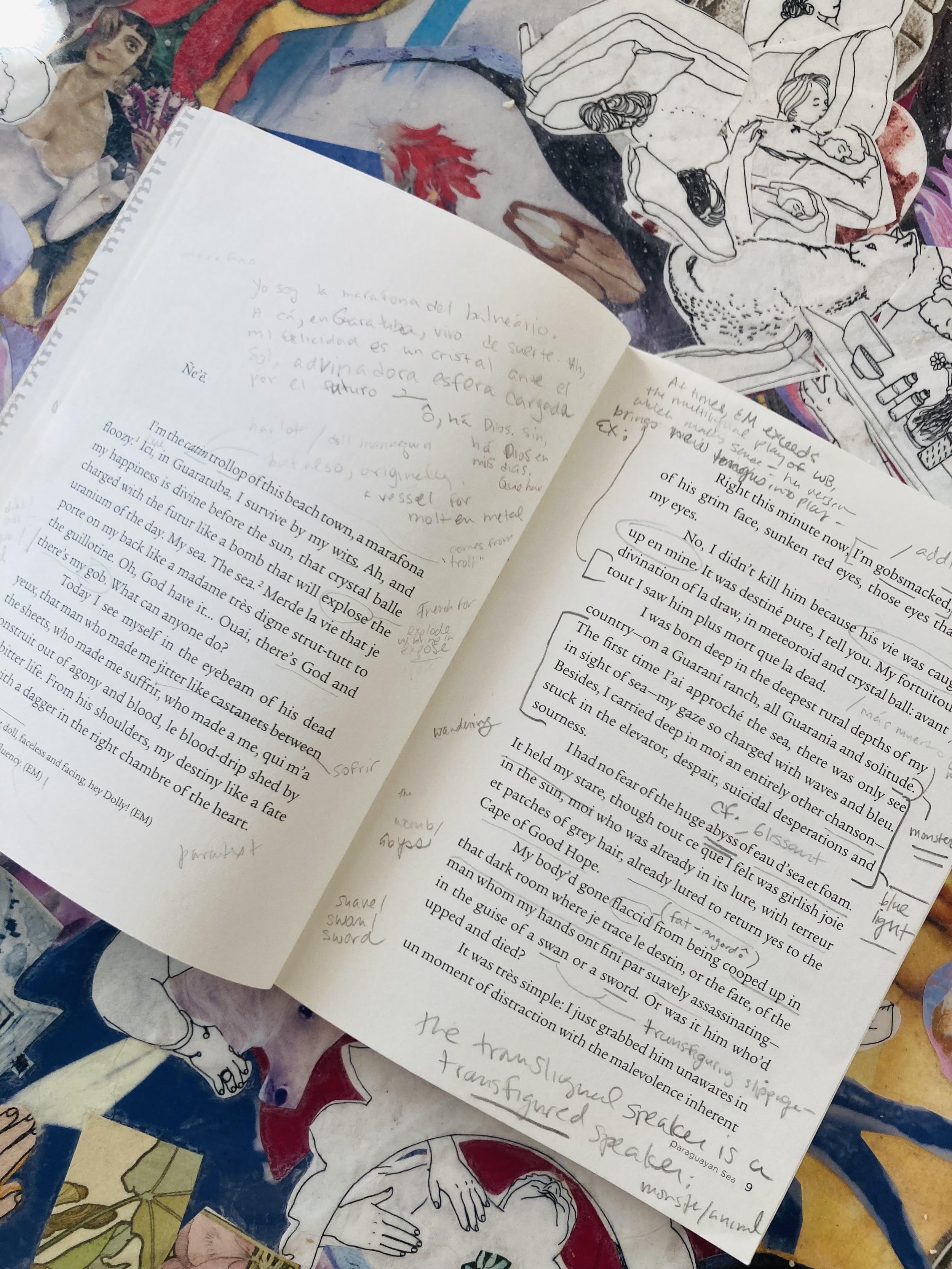
“As the marafona’s confessions and non-confessions cross-write the story, far more interesting than ‘what (really) happened’ are the fascinations of an interpretive universe in which contradictions pile up. I love how this piling, rather than feel futile or overwhelming-in-a-bad-way, pulls us closer to the language. Death and rebirth, gods and gobs, seafoam and formaldehyde, faits [facts] and fates are hopelessly tied together in a “tangle web webtangle” of Paraguayan lace. [. . .] [T]he real drama is the language/s, how it twists to permit so much contradiction.“

“Books that have been loved for generations and passed down to me to love in turn hold a sacred space in my personal library—my maternal grandmother’s books in particular, for she was a bibliophile and her volumes keep coming to me (as gifts from my mom); and it is through her books, her interests, her bookplates, her inscriptions, her marginalia, etc., that I have formed a relationship with her at all. She was a solitary, elusive figure throughout my childhood, and her library is my only way of reaching her.”

“The DC-area anarchist poet Wade Fletcher (author of the Dusie chapbook Snitch Culture) used to listen to a CD of a Myung Mi Kim reading while working at a gas station in Woodbridge, Virginia after midnight in 2006, 2007. Imagine it among the racks of Lay’s potato chips, the boxes of cigarettes stuffed together behind the counter . . .”
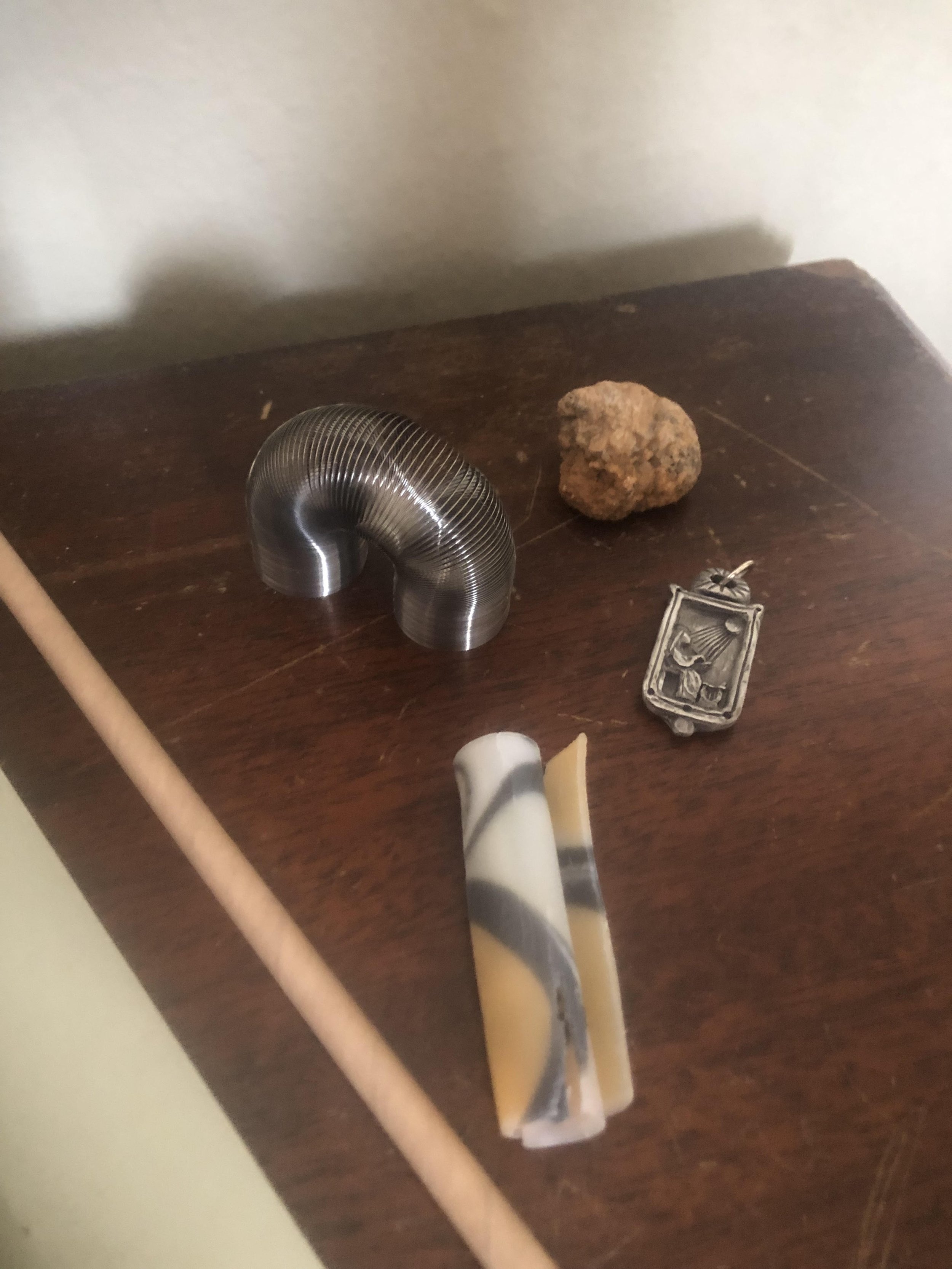
“Hayden writes about something that I understood in my bones, the coldness and fear and loneliness of a home, but had never talked about to anyone nor heard anyone else speak about, at least not in any way that felt real: feeling a kind of shame and then feeling a kind of shame for one’s shame. Up until that moment, I thought maybe I would just live my whole life in silence.”
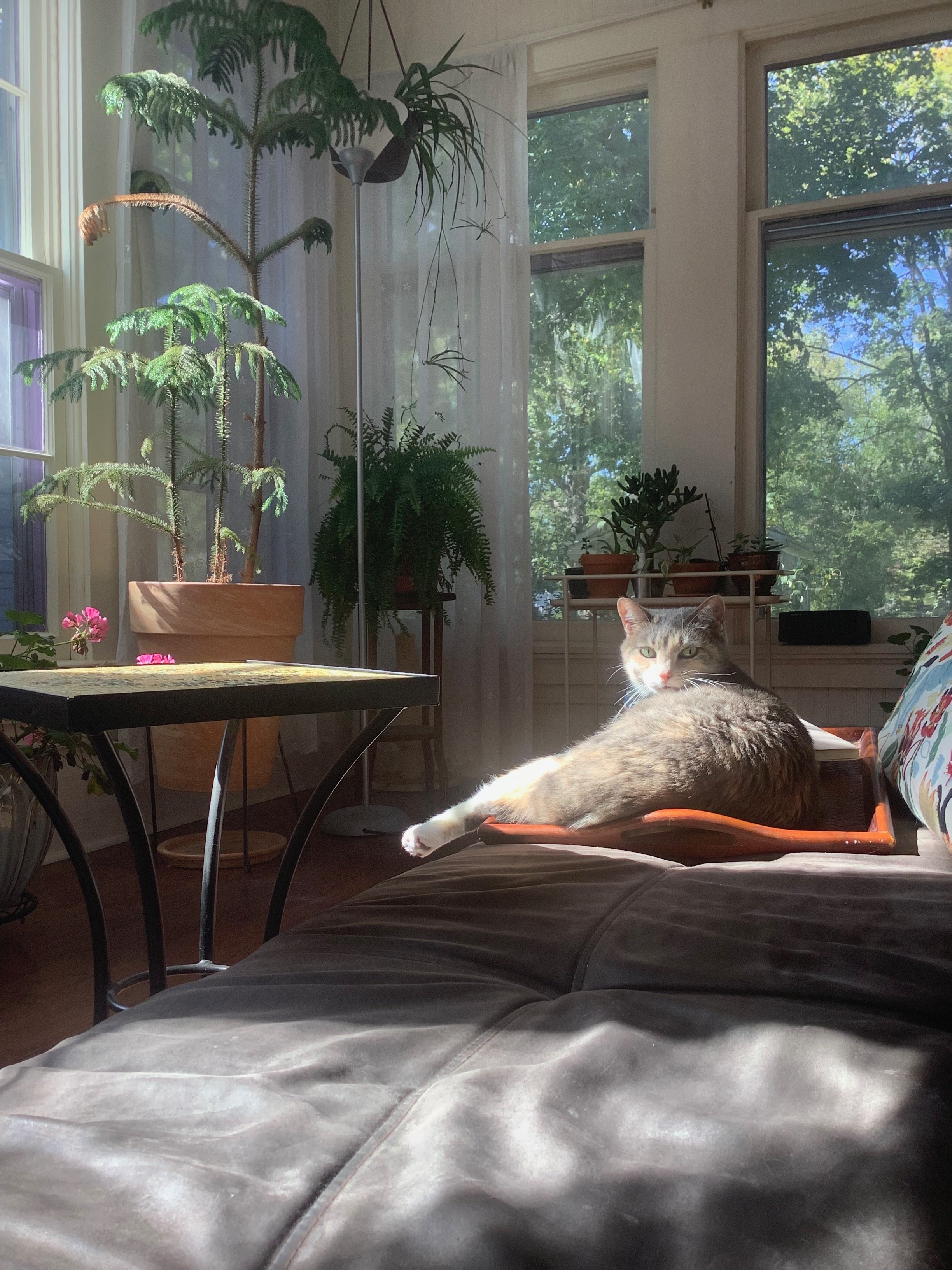
“It’s been about twenty years since I’ve called Virginia Beach home, and, while I didn’t think of myself as a poet when I was growing up there, the landscape of the place and the shadows of its histories are certainly imprinted deep in my memory and body. [In Black Pastoral], Benson brings silenced histories and the thickness of place into dazzling form, complicating the romantic tradition of the pastoral into something more vital, vibrant, and multivalent.“

“Beckett was recommended to me by the graduate student who taught my Introduction to Creative Writing class my freshman year of college, which, for those counting, was in 2002. This was after I had submitted a one-act play where two characters called Pim and Pam lobbed a ball back and forth over a very high wall. I can’t remember what they were talking about, but you can see why he made the connection..“

“Each time I read Acid Virga (Archway Editions, 2020) I think, who IS this person? even as my brain knows it’s Gabe (Gabriel Kruis), among the dearest people to me on earth. I think we’re meant to feel this sense of remove, like we’re encountering the poet’s reflection (projected, astral, film-like) as he traverses memory, drugged perception, forwarding verse, inducing waves of euphoria and despair in the heart and mind.”

“There are handfuls of books I try to keep close at hand at any given time, knowing how often I might return to them. […] Why is there a puppet on the floor? Occasionally the shelves overwhelm. Only today, our five year old suggested I need to give away some of my books. I must have one hundred books, she said. […] Anytime I’m asked what titles I return to, I know I only have to look around my immediate vicinity to properly respond. There are easily far more that I simply can’t see from where I am. Books buried underneath other books.”
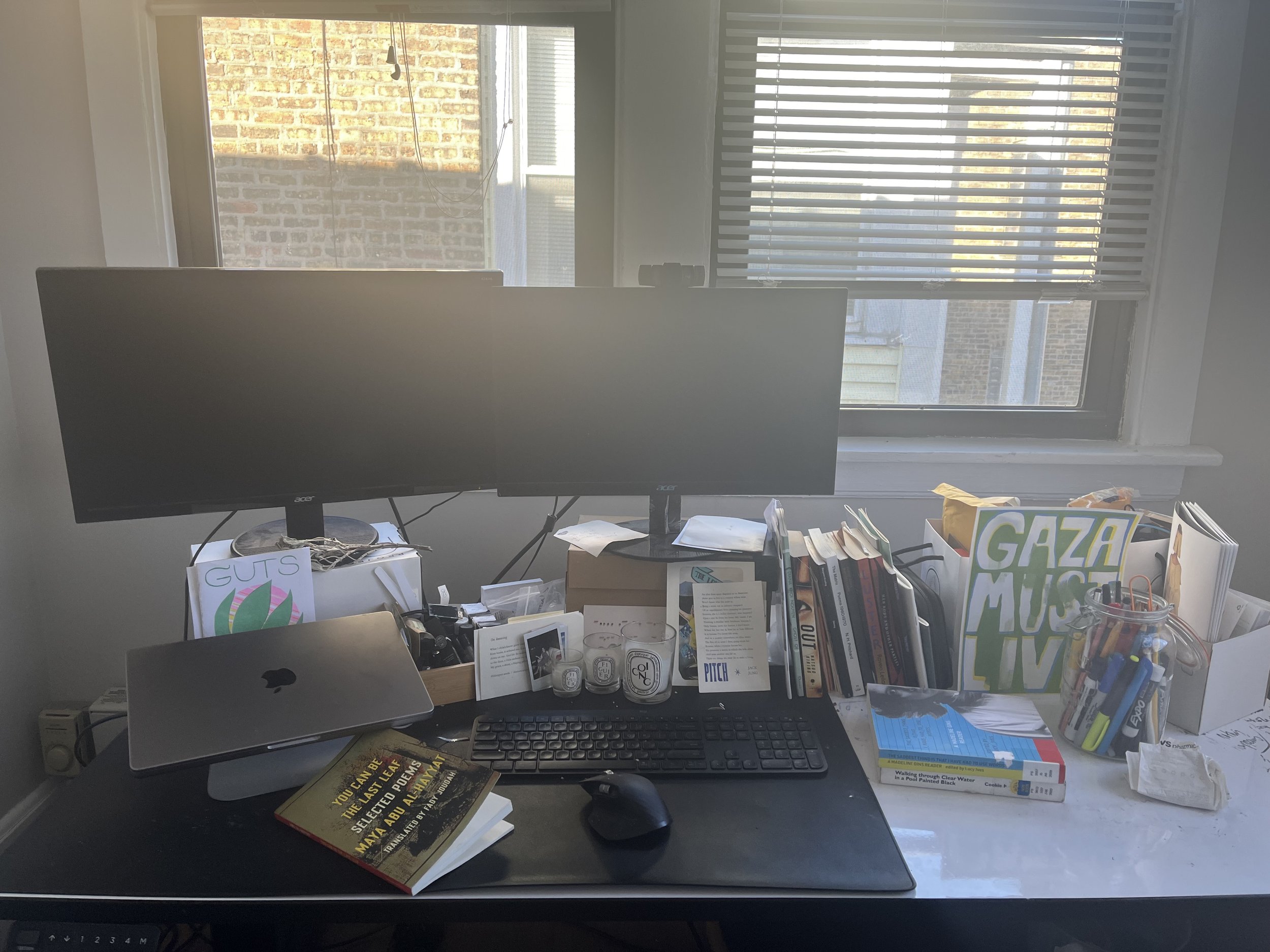
“I hesitate to call it performance, the icky connotations of that, but this text is performing in the most denotative sense. You will–I did–catch your breath at the curving, eliding, congregating, dispersing. This is a gorgeous, brutal visual work. I am so excited about this poet. I want everyone to read this chapbook. I feel Pritchard in the lines. I accept the instruction on how to be il/legible, numerous. I learn how to be a bit more resistant to my own exploitation.”

“It’s Creeley's duty to the commons — to all that is available of emotional, intuitive perception — that pressures me and pushes me when I’m in a lull. I think he gives us the license to be people speaking in our poems not notions of people or themes of people but us with our intangibles and incoherences and rhythmic (illogical) connections. The work of New Mexican abstract expressionism (like Agnes Martin) is for me a transcendental individualism. . . “
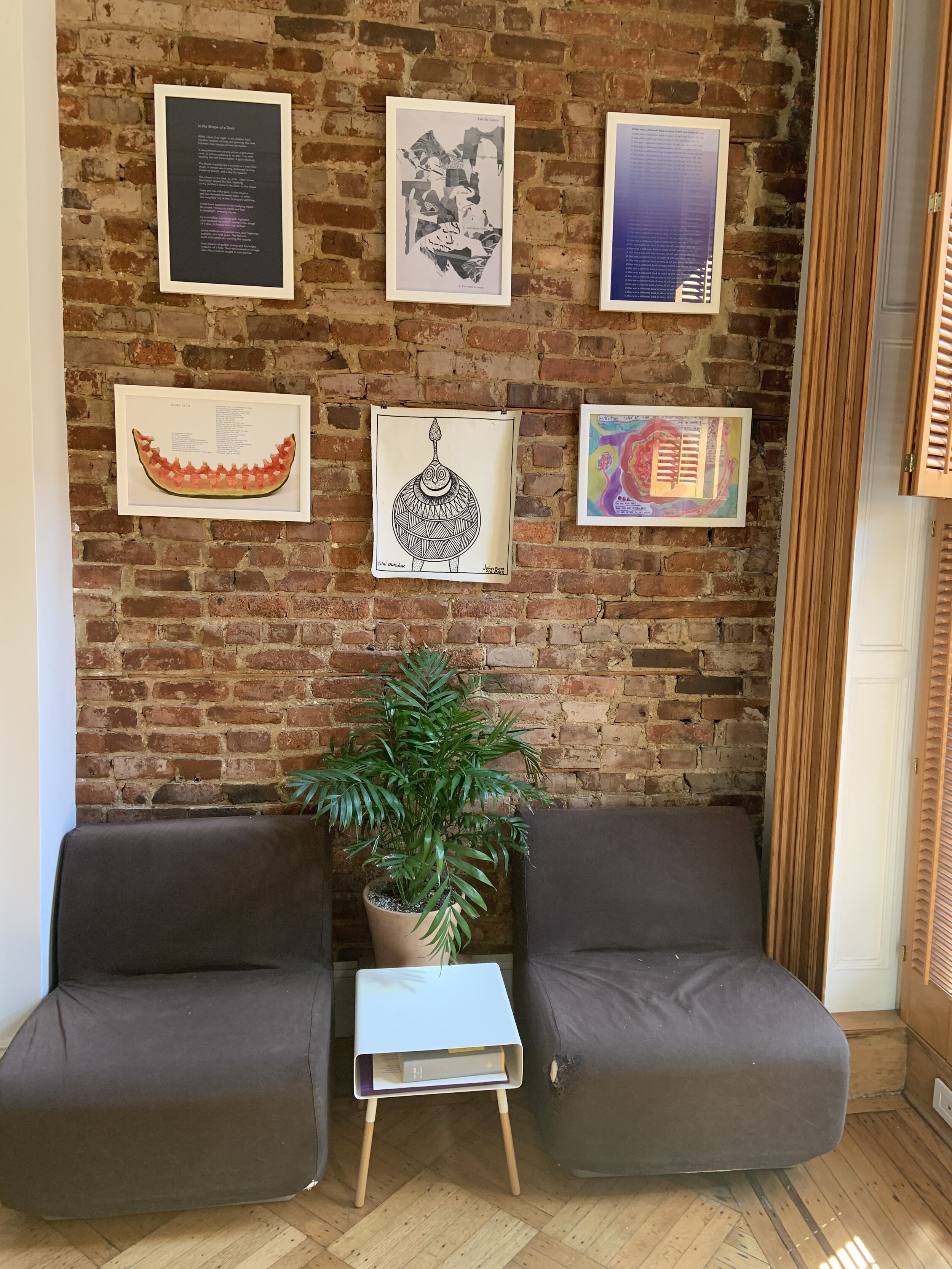
“It wasn’t “The Highwayman” I liked but Anne’s recitation of it in the CBC adaptation of Anne of Green Gables, which I watched as a very young child, before I was even really literate.”

“I took a trip to Greece where I was supposed to stay with relatives of a colleague of my dad, but they misunderstood when I was planning to come and weren’t home when I arrived in Athens at age 16 alone! Long story short, I ended up spending a week with a woman named Debbie who taught English there. We swam, ate yogurt and honey, listened to her Beatles records. She also played me a Loreena McKennitt version of Yeats’ “The Stolen Child,” and I think she must have had a book of Yeats as well because I remember reading “The Stolen Child” and “He Wishes for the Cloths of Heaven” and then buying a book of Yeats myself shortly after.”

“I think difficult subjects are sometimes best approached with self-aware, messy books, books that stretch themselves into unexpected zones and forms. Some books are too neat for their subject matter, too crafted. As someone working on a project about extraction, the size of the subject can feel overwhelming—I want to talk about it all, and don’t know how to.”